Consider vegetation on Ode's surface / Restore rest functions
 karasu_sv
Exploring the Vegetation on Ode’s Body Surface
I’ve started working on the plants that grow in clusters across Ode’s body.
With TITANCLIMB, I want to create the joy of climbing a mountain that is alive and squirming. But the stages in the current demo are sparse, and they’re simply not interesting to look at or walk through…
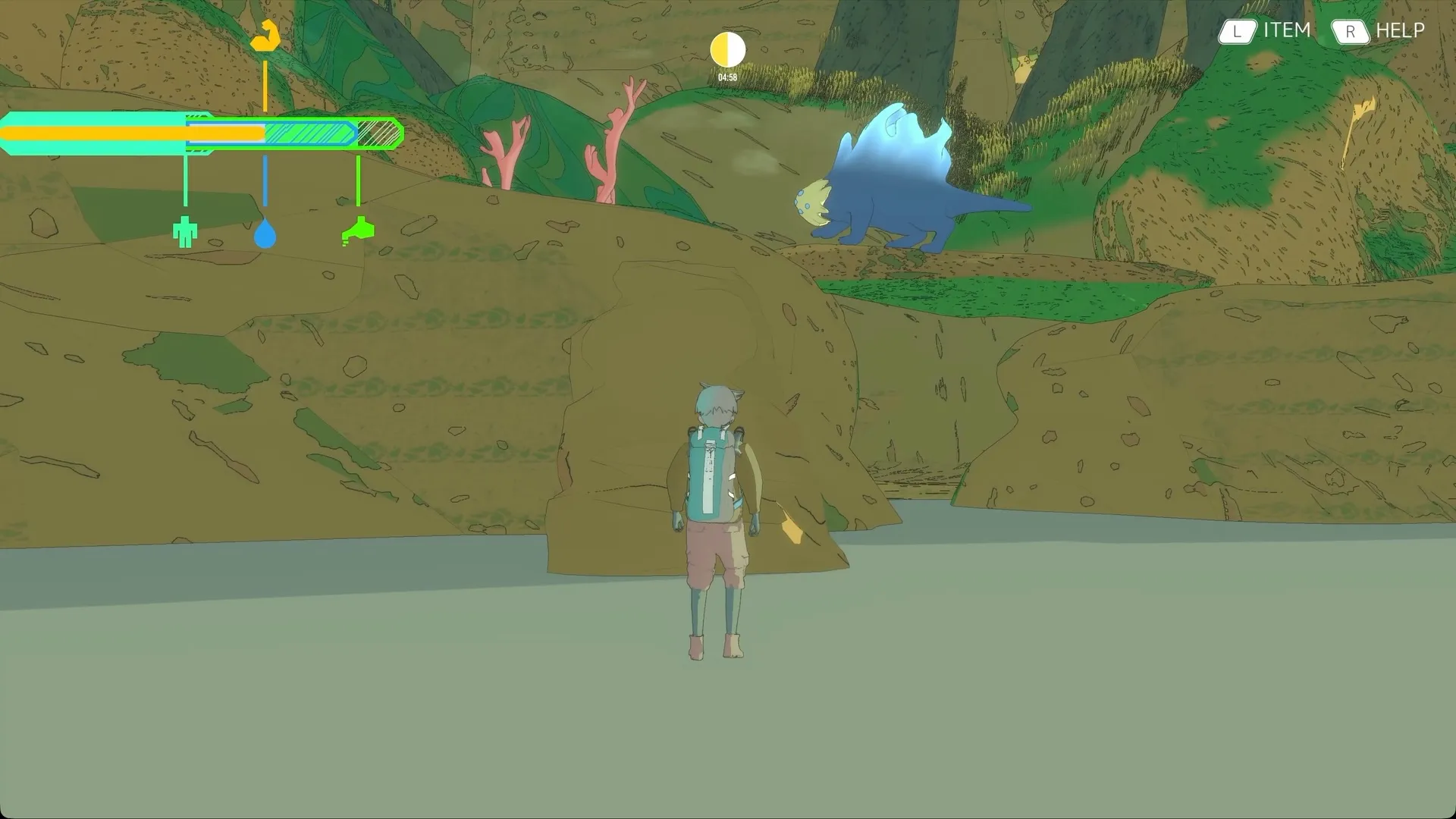
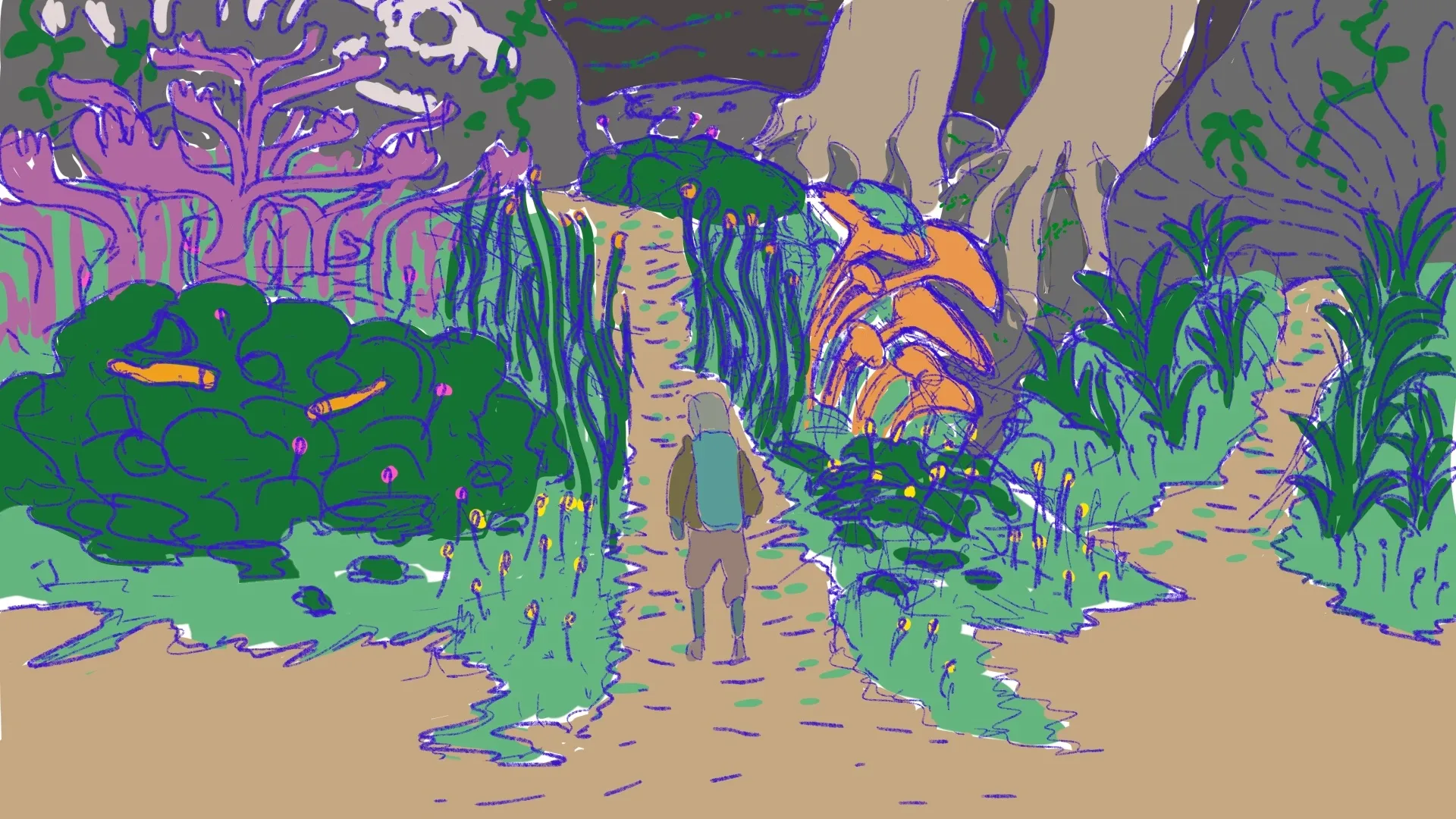
So I took this screenshot as a base and drew a rough sketch, focusing on the question: “How could this be improved to make walking around fun?”
I think this is roughly the density needed to enjoy the changing scenery as you walk.
Also, while looking through various reference materials, I realized I hadn’t actually understood what a “path” looks like, especially on a mountain. Mountains are generally covered in obstacles, big and small, but where there’s a continuous series of gaps in them, we recognize it as “this is the path.” Because I’d been building stages without understanding this basic principle, the demo stage made it hard to tell where to go (or more precisely, it lacked paths you could read as “I can probably get through here,” along with cues for judging how difficult they’d be).
So in the rough sketch, I placed voluminous vegetation on both sides of the entrance, leaving open only the routes that look passable.
I haven’t worked out the details of the plants yet, but I have a general direction in mind.
The game is set on a planet other than Earth, so the plants generally won’t look exactly like ones found on Earth (because that’s more fun, right?!).
I also want the game to carry the DNA of the artist Moebius’s work, so that’s where I’m drawing references from. I’ll write more about why I want to bring in Moebius’s DNA later, but the works to reference are Arzach and Nausicaä of the Valley of the Wind. When I looked at how plants are depicted in these works, most of those in Arzach were real-world succulents, but some resembled ocean coral or sea anemones.
In Nausicaä, the distinctive plants look like giant versions of mosses and fungi.
So I expect the plants in this game will take their motifs mainly from mosses, coral, and seaweed.
The rough sketch already includes a hint of this: in the area on the left, I placed several coral-like plants, along with fish-like creatures swarming around them.
I can’t recall many games where unique plants are depicted in an appealing way. The only one that comes to mind is Nomada Studio’s GRIS.
Its visuals, which interpret the shapes of plants in an extremely simplified way and reconstruct them into beautiful flat-art compositions, really blew me away.
The direction is different, but I hope to make a game where the original plants feel as captivating as they do in GRIS.
I didn’t get as far as designing individual plants yet, but once I do, I think I’ll need a “Plants” section in the WORLD category…
By the way, while searching for reference material on mountains and vegetation, I found a reasonably priced and fascinating book. It’s packed with photos and explanations of mountain vegetation that looks beautiful, and I relied on it quite a bit this time.
日本の自然風景ワンダーランド: 地形・地質・植生の謎を解く (Japan’s Natural Landscape Wonderland: Unraveling the Mysteries of Landforms, Geology, and Vegetation)
Bringing Back the Rest Feature
In an earlier demo, I had implemented a “rest” feature that let you sit down anywhere you liked.
But when I later revisited the life and stamina gauge systems, I set that feature aside for the time being. (Back then I was too focused on resting itself, and I’d lost sight of the challenges and stamina design needed to make resting feel cathartic.)
The life and stamina systems now have a fairly settled direction, and when I reconsidered resting with that in mind, I concluded that the game really should have a rest feature.
That said, past testing has shown that if resting just means “sit down and your stamina recovers,” it feels like a chore and becomes boring.
Cairn had clever touches like pitching a tent when resting to stay safe, and adding cooking as a play element. TITANCLIMB may not use tents, but I’m planning to include some kind of playful mechanic in resting.